AI-Assisted Software Development Technologies
At Bravent, we help organizations incorporate artificial intelligence into their development processes through leading market solutions such as Claude Code and GitHub Copilot, adapting the strategy to the needs, objectives, and maturity level of each team.
Our approach is not about promoting a single tool.
We believe that Claude Code and GitHub Copilot are complementary solutions within the AI-assisted development ecosystem, and that the real value emerges when these capabilities are integrated into a methodology, governance framework, and adoption strategy aligned with business goals.
Artificial intelligence is already transforming software development. The question for technical teams is no longer whether to use AI, but how to incorporate it into the way they work without losing control over code, architecture, and technical decision-making.
Tools such as Claude Code and GitHub Copilot help accelerate programming, documentation, testing, and code analysis tasks. However, as AI becomes part of mission-critical projects, organizations face a greater challenge: establishing processes that preserve quality, traceability, and technical control as adoption scales across teams.
At Bravent, we have designed a Claude Code adoption program for development teams that combines technology, methodology, and enablement to unlock AI-driven productivity while maintaining technical oversight.
How to Adopt AI in Software Development Without Losing Technical Control
Most development teams that begin using AI encounter the same reality:
The tool can write code, but it cannot replace the technical judgment of the team.
Claude Code can understand repository context and assist with code exploration, implementation, debugging, Git operations, and workflow automation.
Similarly, GitHub Copilot can accelerate coding and productivity tasks directly within developers’ everyday environments.
The key is not choosing one tool over another. The key is integrating these capabilities into a controlled process aligned with the organization’s engineering standards.
The challenges are typically the same:
- Pressure to deliver faster with the same resources while maintaining software quality.
- Loss of technical control, increasing the risk of technical debt and insufficiently reviewed changes.
- Unstructured adoption, where every developer uses AI differently and without shared standards.
- Security and compliance concerns, including defining what information the model can access, which tools it can use, and what permissions it has within the environment.
The question is not how much code AI can generate.
The question is how much control the team can maintain while using it.
Claude Code Adoption Program for Development Teams
This is not about adding another license to the technology stack.
It is about enabling teams to work differently.
Our adoption program combines three core elements.
Copilot: Claude Code
Claude Code is Anthropic’s development agent, integrated into the team’s working environment. It can explore repositories, edit code, execute commands, and assist with debugging, testing, refactoring, and Git workflows.
Its adoption can coexist seamlessly with other AI-assisted development tools such as GitHub Copilot, forming part of a broader strategy for engineering productivity and collaboration.
Methodology: Spec-Driven Development (SDD)
Specifications become the central element of the development process.
Senior engineers retain responsibility for technical decisions.
AI executes within clearly defined boundaries.
Team
Developers evolve from a model focused on writing every line of code to one where they guide, review, validate, and make decisions about AI-generated work.
Bravent is part of the Claude Partner Network, an initiative designed to help organizations deploy Claude in production environments through expertise, resources, and support.
The objective is not simply to introduce Claude Code. The objective is to make AI a real capability within the team.
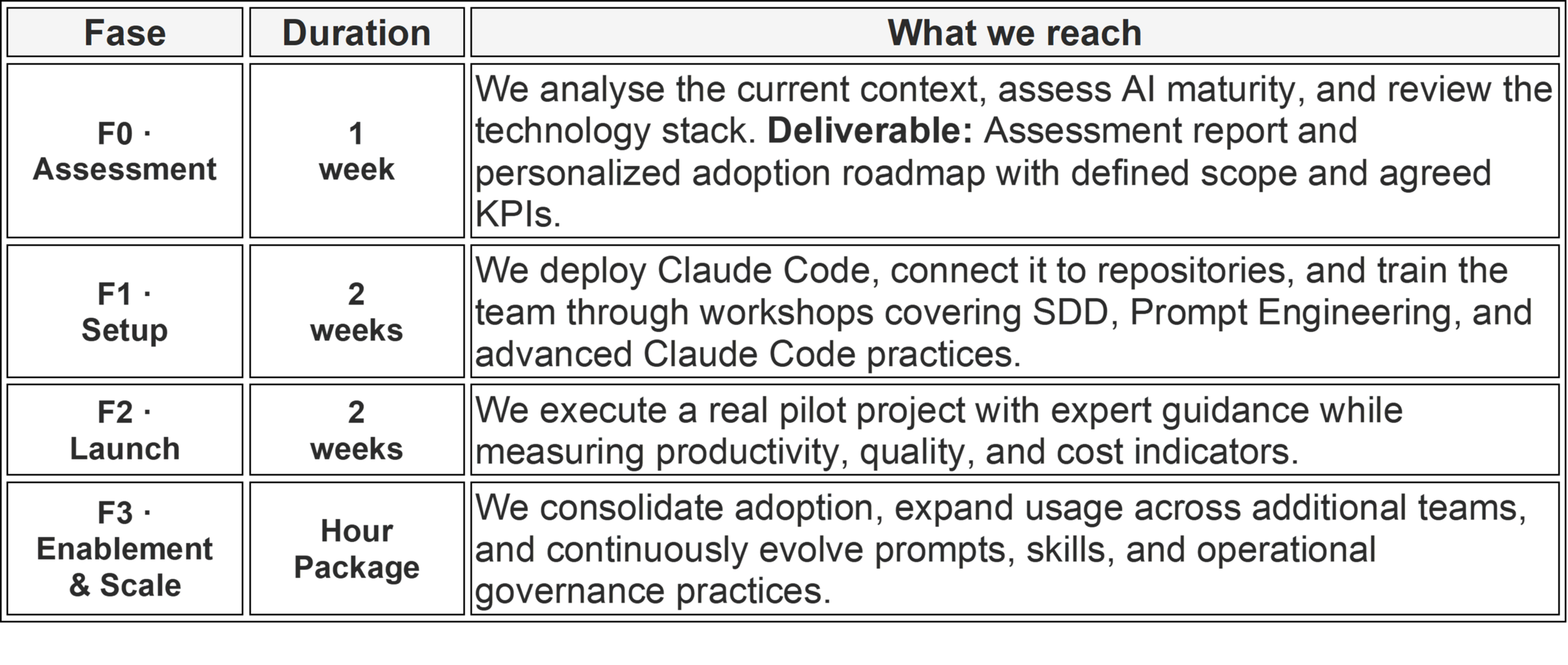
Claude Code Deployment in 5 Weeks
Each client receives an adoption journey tailored to their starting point. An initial AI maturity assessment determines the approach, priorities, and program pace.
Measuring the Impact of Claude Code on Productivity and Quality
Adoption must be demonstrated through measurable outcomes.
From the earliest stages, we track indicators such as:
- Time required per task
- Cost per deliverable
- Acceptance rate of AI-generated suggestions
- Static code quality through tools such as SonarQube
- Team adoption metrics
- Impact on development cycle times
The question is not whether AI appears faster. The question is whether the data proves it is improving the process.
The organizations achieving the strongest outcomes are those that successfully balance speed, quality, and governance.
AI Use Cases for Development Teams
This approach is particularly valuable for organizations that:
- Already use tools such as Claude Code or GitHub Copilot.
- Are exploring new AI-assisted software development approaches.
- Need to accelerate development while maintaining technical control.
- Want to improve productivity without increasing technical debt.
- Require governance and traceability for AI usage.
- Need to scale adoption across multiple teams.
New Digital Product Development
AI can support requirements exploration, project structuring, implementation acceleration, and productivity improvements from the earliest development stages.
Legacy Application Modernization
AI can help analyze existing systems, identify modernization opportunities, and accelerate transformation initiatives while maintaining technical control over critical architectural decisions.
Ready to Start?
The best place to begin is with an Assessment.
In just one week, we analyze your current situation, identify improvement opportunities, and design an adoption roadmap tailored to your technical and business context.
Because adopting AI is not about installing a tool.
It is about transforming how teams build software.
Contact us at info@bravent.net or reach out through our contact page.